Zelenskidesigns
Website - Graphics - Design

Santa Monica to Needles

Santa Monica
The original terminus of U.S. Route 66 was at 7th and Broadway in downtown Los Angeles. However, over the years, and decades, Route 66 has had several “official” and “unofficial" ending points. Federal Highway rules stated one highway must feed into another to not "dead-end" a traveler, so Route 66's new ending was re-routed to connect with "Alt 101," today's California Pacific Coast Highway.
The extended route was at the intersection of Lincoln and Olympic boulevards in Santa Monica, about one mile from the Pacific Ocean. This is often referred to as the official ending point of Route 66.
Several Mels restaurants are located in the Los Angeles area, including this one at 1670 Lincoln Boulevard, near the official ending point of Route 66.

Describe your image
Describe your image
Pasadena
California Street Bridge
With its majestic arches rising 150 feet above the deeply cut Arroyo Seco, the Colorado Street Bridge was proclaimed the highest concrete bridge in the world upon completion in 1913. The bridge connected Pasadena to Los Angeles, and traffic on the new bridge was heavy. Only two lanes wide, the bridge was considered inadequate as early as the 1930s. The bridge remained part of Route 66 until the 1940 completion of the Arroyo Seco Parkway. It was listed in the National Register of Historic Places in 1981.

Rancho Cucamonga
The Cucamonga Service Station is a historic gas and automobile service station located in Rancho Cucamonga, California.
Located on Historic Route 66, it was built in 1915 and today serves as a museum. The official address is 9670 Foothill Blvd, Rancho Cucamonga, CA 91730.
Chicken Boy in Los Angeles
The 22-foot high, fiberglass Chicken Boy, is part man and part chicken, and holds a yellow bucket of chicken. Chicken Boy was originally located on the roof of the Chicken Boy restaurant on Broadway in Los Angeles. It was later put in storage, and then relocated to its current site atop the Future Studio Gallery, on 5558 North Figueroa Avenue, part of Historic Route 66, in the Highland Park area. It is commonly called the "Statue of Liberty of Los Angeles".

San Bernardino
The second-largest city in the "Inland Empire" and home to a stretch of the legendary Route 66, San Bernardino has long been the gateway to Southern California. Rancho Cucamonga lies to the west, and Riverside to the south. It is about 60 miles east of Los Angeles.
San Bernardino was named in 1810, when Spanish priest Francisco Dumetz led an expedition through the area. Traveling in covered wagons, Mormon pioneers descended through Cajon Pass in 1851 and settled at the base of the mountains. Later San Bernardino grew into a railroad town with the 1875 arrival of the Southern Pacific and later, the Santa Fe Railway.
Today, the restored 1918 Santa Fe Depot, a Mission Revival national historic landmark notable for its domes and towers, is home to the San Bernardino History and Railroad Museum, which tells the story of both the city and the railroad.
Starting in the 1920s, San Bernardino served as an oasis for travelers after their arduous journey across the Mojave Desert along Route 66, the 2,448-mile highway that connected Chicago and Santa Monica. Many motor courts and motels in San Bernardino gave overnight refuge to Route 66 tourists.
Just off Route 66, there’s more dining history at the site where the first McDonald’s opened in 1948. An unofficial McDonald’s museum founded by Albert Okura preserves a huge collection of early memorabilia.
San Bernardino is also home to an iconic Route 66 landmark, the Wigwam Motel, where you can sleep in a 32-foot-tall concrete teepee. Among the most photographed of all Route 66’s roadside attractions, San Bernardino’s Wigwam was built in 1949 and is one of only two of these “Wigwam Villages” that survive from the highway’s heyday.
Wigwam Motel No. 7
Driving down Route 66, this San Bernardino motel immediately grabs your attention with its one-of-a-kind roadside architecture.
In 1933 Frank Redford started developing the Wigwam “Villages” by designing teepee (tipi) shaped motel units. This was the last of seven Wigwam Motels built across the country; only three survive today. The others are located in Holbrook AZ and Cave City KY.
This one was opened in 1949, and remains open today at 2728 E. Foothill Boulevard, and welcomes travelers to "sleep in a teepee".


Victorville
California Route 66 Museum
The California Route 66 Museum is devoted to the representation of U.S. Highway 66 in both historic and contemporary exhibitions. It is an interactive museum with over 4500 Sq. Ft. of floor space. The museum offers many photo opportunities for visitors to share memories in such settings as a 1950s diner and the VW Love Bus complete with hippie wigs and sunglasses for that perfect photo op.
The building was built in 1930 as the "Red Rooster" and later served as the "Les Pyrenees Restaurant". The museum is dedicated to "those who lived, passed through, or passed on here".
Located at 16825 South D Street in Victorville, California - Phone 760.951.0436
Emma Jean's Holland Burger Cafe is a Route 66 icon that has been serving up meals to locals and hungry travelers on the Mother Road in Victorville since 1947. The building was built by Bob and Kate Holland from cinder blocks manufactured at the old Fiber Tile Plant. Emma Jean worked at the cafe as a waitress, and her husband bought the cafe and named it after her.
The cafe remains a family-owned institution, and because of its nostalgic Mid-Century ambiance, it has been featured in a number of movies and TV shows.
Emma Jean's is located at 17143 N D Street, Victorville, CA 92394 - Phone 760.243.9938

Barstow
Barstow Harvey House
Originally built in 1911 as Casa del Desierto, a Harvey House hotel and Santa Fe Railroad depot, it currently serves as an Amtrak station and government building housing city offices, the Barstow Chamber of Commerce and Visitor Center. It is also home to the Western America Railroad Museum.
681 North First Avenue Barstow, CA 92311
Route 66 Mother Road Museum
A popular stop for those interested in the history of the old road is the Route 66 Mother Road Museum at 681 N. First Street in Barstow.
Western America Railroad Museum
The Museum is dedicated to sharing the history of railroading in the Pacific Southwest. It features both indoor and outdoor displays and is popular with railroad enthusiasts. It is located at 685 North First Street in Barstow, at the Barstow Harvey House.
Indoor displays include timetables, uniforms and other railroad memorabilia. Several locomotives and rail cars are located outside.


Newberry Springs
Bagdad Cafe is a memorable Route 66 restaurant located at 46548 National Trails Highway in Newberry Springs, California. Famous among mother road travelers, this iconic roadside stop captures the spirit of the classic American road trip with its quirky charm, desert surroundings, and cinematic history. Visitors exploring route66 can enjoy a unique dining experience in the Mojave Desert while taking in one of California’s most recognizable highway landmarks. Bagdad Cafe stands out as a must-visit restaurant for travelers seeking authentic nostalgia, photo-worthy scenery, and a true taste of historic Route 66 culture. Whether you are passing through Newberry Springs or planning a dedicated mother road adventure, Bagdad Cafe offers a distinctive stop that blends history, atmosphere, and road trip appeal.

Ludlow
The original dirt trail from Los Angeles to New York passed through Ludlow and it became Route 66 in 1926. The travel guides of that time reported that Ludlow had " Hotel - gas - oil," clearly the town was switching from an economy based on the mines and the railroad to one based on catering to travelers moving along U.S. 66.
Over the next few years, the highway was improved, straightened out, widened and better bridges built. It was also paved by the early 1930s.
After World War II, diesel engines replaced the old steam locomotives. Water stops were no longer necessary. So the railroad became even less important to Ludlow. business focused on US 66 and did so for the next 25 years until I-40 opened in 1973 and bypassing Route 66 between Ludlow and Needles. Ludlow declined rapidly.

Amboy
Roy's Motel and Café is a historic site on U.S. Route 66 in the Mojave Desert town of Amboy in San Bernardino County, California. Roy's Motel and Café is a 24-hour gas station, gift shop, and famous tourist attraction, due to its 1950s Googie-Style neon sign that can be seen for miles approaching the town.
Amboy was first settled in 1858; Lewis Kingman, a locating engineer for the Atlantic and Pacific Railroad, created the town as the first of a series of alphabetical railroad stations that were to be constructed across the Mojave Desert.
In 1926, Amboy became a boom town after the opening of U.S. Route 66. In 1938, Roy's Motel and Café opened and prospered due to its isolated location on the route. Roy's was later purchased by the late Albert Okura who worked to restore and revitalize the area.
Two extinct volcanoes are located west of the town: Amboy Crater and Pisgah Crater.


Goffs, California
Goffs, an unincorporated community about 40 miles west of Needles in San Bernardino County, California, is a nearly empty one-time railroad town at the route's high point in the Mojave Desert. Goffs was a stop on Historic U.S. Route 66, and jogged around the White Cottage Restaurant. In 1931 a more direct Route 66 alignment opened between Needles and Essex.

Needles
Needles is located in San Bernardino County in the Mojave Desert on the western banks of the Colorado River. The city was founded in 1883 during the construction of the Atchison, Topeka and Santa Fe Railway, and was later incorporated in 1913.
The famous El Garces Harvey House, built by the railroad, is today on th National Register of Historic Places.
Needles was a major stopping point on Historic Route 66 beginning in the 1920s and continuing through the 1960s, when the route was discontinued and replaced by Interstate I-40. The city was the locale of numerous tourist courts, motels and diners, catering to the traveling public.
Old Trails Bridge
From the day it opened in 1914 near Topock, this graceful arch and the deck it supported were a pivotal Colorado River crossing, first on the transcontinental National Old Trails Road and, by 1926, on Route 66. The Old Trails Bridge carried traffic until 1948 when cars and trucks began moving onto interstate systems. In 1948, the deck was removed so the bridge could accommodate a natural gas pipeline, which it still carries. The bridge was listed in the National Register of Historic Places in 1988. The bridge is located several hundred feet south of the I-40 bridge, near Topock, AZ, and Needles, CA.
Needles Regional Museum
Located right across the street from the El Garces Harvey House, the Needles Regional Museum displays many artifacts from the area. It features exhibits about local history, Santa Fe Railroad, Harvey House, Route 66, historical photographs, Mojave Indian bead work and pottery.
Visit the museum at 929 Front Street, Needles CA 92363 Phone 760.326.5678


Oatman
The Drulin Hotel, built in 1902, did a brisk business to the area miners. This old hotel, renamed the Oatman Hotel in the 1960s, is the only historic two story adobe building in Mohave County. In 1930, it was estimated that 36 million dollars worth of gold had been mined around Oatman. The town boasted two banks, seven hotels, twenty saloons and ten stores. There were over 10,000 people living in Oatman area.Today, the popular small town of Oatman is an interesting stop, with numerous gift shops and small restaurants. It is located at elevation 2,700 feet on old Route 66 (Highway 10, Oatman Highway) between Kingman, Arizona, and Needles, California.Oatman's famous "Wild" Burros that wander the streets are the descendants of burros brought here by the miners, and when no longer needed were turned loose. The Oatman Bed Race is a popular annual event held in late January.The original 1926 Route 66 alignment ran southwest out of Kingman through Cool Springs to Oatman, and onward to Golden Shores and Topock where it turned west to Needles, California. Today, travelers headed to Oatman from the Kingman area get to experience the famed Arizona Sidewinder: 191 turns, 8 miles of Historic Route 66, with no guardrails!


Kingman
The Atlantic & Pacific Railroad (later the Atchison Topeka and Santa Fe Railroad) reached the area in the early 1880s. A station was built, and Kingman was founded in 1882. Its post office opened in 1883. Kingman became the county seat in 1887 (formerly it was located at Fort Mohave), and it grew in importance as a shipping point for the region's mines and ranches.
The National Old Trails Highway (N.O.T.), a rough and primitive highway, reached Kingman in 1914.
In 1952, the Route 66 alignment was changed, running from Kingman through the small town of Yucca and then into California. This alignment is essentially the same as present-day I-40 from Kingman to the Colorado River at California.
Route 66 was created in 1926 and followed the N.O.T. roadbed. The building of Hoover Dam (1931-36) and the World War II airfield contributed to the town's economy. By 1952, mining had dwindled so the Route 66 alignment through Sitgreaves Pass and Oatman was replaced by a new one that ran along level ground, through Yucca.


Hackberry
Hackberry is known a small village in Arizona best known for the Hackberry General Store (The Northside Grocery).
It is located on the original alignment of Route 66, now known as Historic Route 66.
In 1848, after defeating Mexico, the U.S. incorporated this territory as New Mexico (later it split Arizona as a separate territory).
In 1851 the area was explored by Captain Lorenzo Sitgreaves. He was followed six years later by Lt. Edward Fitzgerald Beale (1822-1893) who was commissioned with opening and surveying a wagon road along the 35th parallel from Fort Smith in Arkansas to California. Beale passed through Hackberry and named the spot "Garden Spring". His route was used by many settlers on their waye to California and one of them, Charles Cummings, established a ranch here in the 1870s. Shortly after, silver was discovered by Jim Music (1875) and the community grew. The post office opened in 1878.
The mine was named Hackberry after a Hackberry tree which grew beside a spring on the hill where the mine was located.
The National Old Trails highway (N.O.T.) was built in the 1910s through the village, which was sustained mainly by a few small mines and ranches, however, by 1919 the mine had exhausted the silver ore and closed. It was not until Route 66 was aligned along the N.O.T. in 1926 that traffic and new business reached the area.


Peach Springs
Peach Springs is a town located in the Hualapai Indian Reservation with two historic Route 66 landmarks: the Historic Peach Springs Trading Post, and John Osterman's Shell Station and the sites of the now gone Osterman Auto Court and Qumacho Cafe. From Peach Springs and its tribal resort hotel you can visit the Grand Canyon and do some rafting at Diamond Creek, and Hualapai Falls or the Skywalk on the Grand Canyon's rim.
Elevation 4,780 ft. (1.457 m). Population 1,580 (2025).
Time zone: Mountain (MST): UTC minus 7 hours. Summer (DST) no DST⁄ PDT (UTC-7).
Peach Springs is a town located on the western border of Mohave County, in northwestern Arizona. On the historic Route 66 segment south of the Grand Canyon. Peach Springs serves as the administrative headquarters of the Hualapai people, and is located on the Hualapai Reservation. The Northwestern part of Arizona has been populated for at least ten thousand years and during the historic period, the Havasupai (also known as Supai) and the Hualapai people lived here.


Seligman
Seligman is the place where Route 66 was reborn in Arizona and rescued from oblivion.
This town is located on the western Arizona section of the Mother Road and has many Route 66 classic spots.
Elevation 5,242 ft (1.598 m). Population 851 (2025). Time zone: Mountain (MST): UTC minus 7 hours. Summer (DST) no DST⁄ PDT (UTC-7). In the 1940s, Pacific Time Zone began in Seligman.
Seligman is a town located on the northern border of Yavapai County, in northwestern Arizona. It has been called "a flat spot in the desert" due to its meadows surrounded by high mesas.
Northwestern Arizona has been inhabited for over 10,000 years. The Native American Havasupai (also known as Supai) and the Hualapai people were farmers who lived to the north and west of what is now Seligman in the Grand Canyon region.
After its independence in 1821, Mexico assumed sovereignity over the territory but lost it to the U.S.A. after its defeat in the Mexican American War of 1846-48.
Lt. Edward "Ned" Fitzgerald Beale was commissioned by the U.S. government to survey and open a wagon trail from Ft. Smith (Arkansas) to California. He passed through what is now Seligman.


Ash Fork
Ash Fork is a small town west of the San Francisco mountains, where the juniper forests gives way to shrubland.
Route 66 crossed the town along two of its streets one for westbound traffic, the other for eastbound travelers.
Elevation 5,160 ft (1.573 m). Population 483 (2025). Time zone: Mountain (MST): UTC minus 7 hours. Summer (DST) no DST⁄ PDT (UTC-7).
This part of Arizona has been inhabited for at least ten thousand years. To the west were the Sinagua natives who farmed close to what is now Flagstaff. To the east lived the Patayan people, near the Colorado River. The Havasupai and the Hualapai people later lived along the Grand Canyon area. Although Arizona was part of the Spanish Colonial Empire, the region was never settled by them. Francisco Vélez Escalante, a Spanish missionary explored the area in 1775. Mexico received the territory when it won its independence (1821) from Spain and later ceded it to the U.S. after its defeat in the 1846-48 war. In 1857, the U.S. government sent Lt. Edward "Ned" Fitzgerald Beale on a mission to survey and open a wagon trail from Fort Smith in Arkansas, to California. His route passed a few miles north of Ash Fork and can still be visited: it is the Beale Wagon Road, it was the main route used by settlers moving into California until the railway was built.



Williams
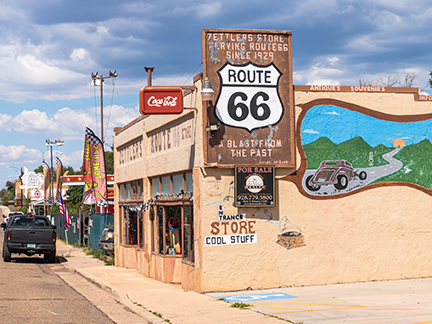
Founded in 1882, Williams was named for Bill Williams Mountain, the volcanic peak that rises above it. The mountain has long been important to native peoples of the region including the Havasupai, Hualapai, Yavapai and Hopi. Williams is located just an hour south of the Grand Canyon South Rim and is known as the “Gateway to the Grand Canyon” because of the variety of lodging choices, activities for the whole family, its connection with Historic Route 66, and plenty of outdoor recreation to enjoy.
The historic Grand Canyon Railway ferries hundreds of thousands of tourists every year from Williams to and from the Canyon. The Kaibab National Forest and the Bill Williams Mountain area provide ample opportunities for camping, hiking and outdoor adventures.
Williams was the last town to have its section of Route 66 bypassed, due to lawsuits that kept the last section of Interstate 40 in Arizona from being built around the town. After settlements called for the state to build three Williams exits, the suits were dropped and I-40 was completed. On October 13, 1984, Interstate 40 was opened around the town and newspapers the next day reported the essential end of US 66.


Flagstaff
Flagstaff is situated in the pines at an elevation of approximately 7,000 feet (2,134 m), near the base of the San Francisco Peaks. Mount Humphreys is the highest point in Arizona and towers above Flagstaff at 12,633 feet. The city is located near the center of Northern Arizona at the junction of Interstate 17 and Interstate 40, about 150 miles north of Phoenix, AZ and 80 miles south of the Grand Canyon. Flagstaff is the county seat for Coconino County, the second largest county in the United States, with an area of 11,896,720 acres.
Route 66 and N. Agassiz St. Start your tour by the steam engine, tender and log wagon built in 1910 by the Baldwin Locomotive Co. Retired in 1966 of the Arizona Lumber & Timber Company. Across the street, facing you is The former Greyhound bus terminal, now Arizona Music (St. view). Head west, passing by the Historic 1890 Railroad Depot and then follow the 1926-34 alignment of Route 66 by turning left, crossing the tracks at San Francisco St. and heading south to Phoenix Avenue. On the SW corner o Phoenix and San Francisco is the former Downtowner Motel. It was originally the home of K.J. Nackard, who owned a store nearby. He converted his home into a motel on Route 66 in the mid 1920s, in 1933 added a "bunkhouse" and in 1935 the wing that enclosed the court.
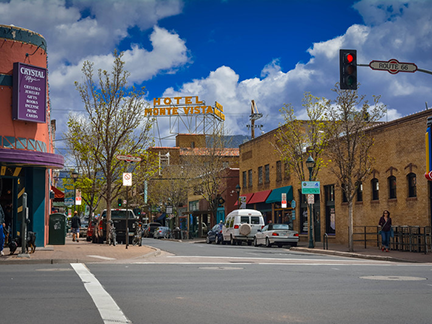
Follow Route 66's 1920s and early 1930s alignment west down Phoenix Ave. to Beaver St. on the corner is the Motel Sierra Vista with its restored neon sign. Head west one block to the SW corner of Phoenix and Beaver. Here is the former 1929 DuBeau Motel Inn with its neon sign on the top of a tower.




Winona
Winona despite being quite small, is one of the towns mentioned in the classic song Get Your Kicks on Route 66, with the line "Don't forget Winona." Its main Route 66 sight has been the Winona Trading Post. It lies on two alignments of U.S. 66, the 1926-1947 "Townsend-Winona Road" (Route 66), and post-1947 one, later replaced by, and partly buried under I-40.
The scenery changes in Winona, the forest replaces the desert, and the volcanos of the San Francisco Volcanic Field come into view.


Meteor Crater
Meteor Crater is something else entirely. It’s a giant hole in the ground, plain and simple, but it’s a hole with a story that’ll knock your socks off. You see, this crater wasn’t formed by some volcano or earthquake; it was created by a rock from outer space, a meteorite that slammed into the Earth with the force of a thousand atomic bombs.
Picture this: about 50,000 years ago, a massive hunk of iron, bigger than a football field, comes screaming through the atmosphere at over 28,000 miles an hour. It slams into the Arizona desert with an explosion that would make your ears ring for a month. The impact throws up millions of tons of rock and dust, creating a crater nearly a mile wide and over 550 feet deep. That, my friends, is what you call a cosmic collision! One of the coolest things about Meteor Crater is the observation deck. They’ve got telescopes set up so you can get an up-close view of the crater floor. You can see the different rock layers, the impact breccia (that’s the jumbled-up rock created by the impact), and even spot some of the meteor fragments that have been found in the area.
Now, here’s something you might not know about Meteor Crater: it’s not just a tourist attraction; it’s also been a training ground for astronauts! Back in the 1960s, when NASA was gearing up for the Apollo missions to the moon, they needed a place where astronauts could get a feel for walking on a cratered surface. And where better than Meteor Crater, one of the best-preserved impact craters on Earth? Astronauts like Neil Armstrong and Buzz Aldrin, the first men to walk on the moon, actually spent time here, learning about geology, practicing moonwalking techniques, and getting used to the challenges of exploring an extraterrestrial environment. It’s pretty cool to think that this place played a role in those historic missions.


Winslow
The city of Winslow lies 34 miles to the west on Historic Route 66 and Interstate 40. Route 66 was the primary east-west transportation artery through Winslow until it was by-passed by I-40 in the late 1970s. This area was dedicated on September 11, 1999, as a tribute to the memorable song of the 1970s by the Eagles band that made Winslow, Arizona a town to sing about. The Standin' on the Corner Park on Route 66 features a two-story mural by John Pugh and a life-sized bronze statue by Ron Adamson named "Easy". It is estimated 100,000 visitors stand on the corner each year! The park is located at the corner of Old Route 66 and North Kinsley Avenue.
A railroad town, Winslow is somewhat linear, stretching mostly east-west along the tracks. It is located about 58 miles east of Flagstaff, and 128 miles west of Gallup, New Mexico. The city is located in Navajo County, and home to nearly 10,000 residents.
Winslow is also the location of the historic Fred Harvey's La Posada Hotel, which remains a popular lodging experience today. In addition to La Posada, several other hotel properties are located in the city.
Other area attractions include the Old Trails Museum, the Winslow Visitor Center, Roxy Theater, McHood Park & Clear Creek, Meteor Crater, the Painted Desert, the Petrified Forest National Park and Homolovi State Park.
Winslow also is the locale of the 9-11 Memorial, constructed of two beams recovered from the World Trade Center Towers in New York City. Be sure to check out the new musical roadway installed in 2025 near the memorial that plays "Take It Easy" when driving at the right speed!
La Posada Hotel
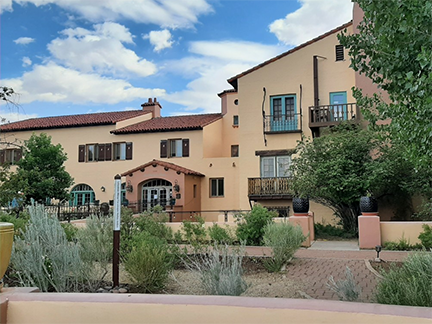
In the 1920s, Fred Harvey wanted to build a major hotel in the center of northern Arizona that would become the finest in the American Southwest. He named the hotel La Posada, "The Resting Place". Opened in 1930, the hotel remains a popular lodging destination today for Route 66 travelers, at 303 East 2nd Street in Winslow.
For current information, visit the Official La Posada Hotel website.




Joseph City
Joseph City is a small town in Navajo county in central-eastern Arizona, on Route 66, it is Arizona's Oldest Mormon Settlement.
Howdy Hanks and the site of now gone Ella's Frontier Trading Post on Main Street. In town you can also see the Old Fort Marker, the Former Pacific Motel and Mural at Old Garage, and drive south to visit the Historic Bridge.
Don't miss Geronimo Trading Post, and drive 6 miles west to Visit the Jack Rabbit Trading Post, with its famous "Here it is!" billboard; a must-see stop during your Route 66 road trip.
Elevation 5,043 ft. (1.537 m). Population 1,908 (2025).
Arizona has been inhabited for at least 10,000 years, but the natives that now live in the area are of a more recent origin. The Ancestral Puebloans or Anasazi, who were an agricultural society, lived on the Colorado Plateau (between the Colorado, Little Colorado, Puerco and Rio Grande Rivers to the south, and Southern Utah and Colorado to the north). They flourished between 700 and 1150 AD, but drought and war pushed them into New Mexico around 1300 AD, originating the Pueblo people. The hunter gatherer Navajo (Diné) people occupied the territory and later adopted farming which they learned from the Pueblo Indians.
In 1539 a Spanish expedition under Francisco Vazques de Coronado reached the area and sent a group of men led by García López de Cárdenas to reconnoiter Arizona. They discovered the Colorado River and became the first Europeans to see the Grand Canyon. Their path took them by Joseph City. The Spanish included Arizona within their province of Nueva Mejico which they established in 1597, nor did Mexico who succeeded Spain in 1821. After the U.S. defeated Mexico in the 1846-48 War, and annexed the region, it explored it and pacified the bellicose Navajos.
His expedition followed the Little Colorado River in this area, passing through the site where Winslow is now located. Beale employed camels, imported from Africa as pack animals. Although they were hardier than mules the Army declined to use them in the future because the camels scared both horses and mules. In 1870 a small fort was established at Holbrook and soon after, the Mormons from Utah moved south into Arizona, they used a trail which was later known as the Honeymoon trail


Holbrook
Holbrook is a city steeped in Native American culture, Hispanic roots and pioneers from all walks of life. The city, located in Navajo County, has a population of about 5,000 residents. Nearby are the beautiful Painted Desert and Petrified National Park, about 18 miles to the east. For those with an interest in geology, Jim Gray's Petrified Wood Company is a fun stop. The Navajo County Historical Museum is well worth a visit as well. And don't miss the dinosaurs at the Rainbow Rock Shop, and the teepees at the Wigwam Motel!
Wigwam Village No. 6
Located at 811 West Hopi Drive in Holbrook is one of the three remaining Wigwam Villages. The other two are located in San Bernardino, California (No. 7) , and Cave City, Kentucky (No. 2). A total of seven Wigwam Villages were constructed between 1936 and the 1950s.
While passing through Cave City, Kentucky in 1938, Chester E. Lewis was impressed by the distinctive design of the original Wigwam Village constructed in 1937 by architect Frank Redford. Mr. Lewis purchased copies of the plans and the right to use the Wigwam Village name. Finished in 1950, Mr. Lewis’ village was the sixth village built, thus its designation as fifteen concrete and steel freestanding teepees are arranged in a semi-circle around the main office. The motel office and its surrounding small buildings were the quarters of the owners. Each teepee is 21 feet wide at the base and 28 feet high, and are painted white with a red zigzag above the doorway. In front of the main office were gas pumps that are no longer in place. While there were a total of 15 units, Mr. Lewis felt that the number "13" was superstitious, so there is no teepee #13, and the last unit is numbered 16.
Elevation 5,082 ft (1.548 m); population 4,812 (2020). Holbrook is the county seat of Navajo county in eastern Arizona, on Route 66. This part of Arizona has been inhabited for over 10,000 years. In more recent times, the Anasazi or Ancestral Pueblo people lived along the Colorado Plateau to the north of the Little Colorado and Puerco Rivers. Their homeland reached from the Colorado River in the west to the Rio Grande in the East. Southern Nevada, Utah and Colorado was their northern boundary. They were farmers who flourished between 700 and 1150 AD; then pushed by war and drought, moved into northwestern New Mexico and originated the Pueblo people ca. 1300 AD. Then they moved to the southwest into New Mexico where they originated the Pueblo People. They had been displaced by other groups, among which were the Navajo (who called themselves Diné - or "People"). They were hunter gatherers of Athabaskan origin, and originated in Canada like the neighboring Apache.
The adopted farming, imitating the Pueblo and later bred sheep and goats (after the Spanish introduced them into the region in the 1600s). A Spanish expedition led by Francisco Vázquez de Coronado explored the area in 1539, and one group commanded by García López de Cárdenas discovered the Colorado River and became the first Europeans to see the Grand Canyon. Their route passed very close to modern Holbrook. They had been displaced by other groups, among which were the Navajo (who called themselves Diné - or "People"). They were hunter gatherers of Athabaskan origin, and originated in Canada like the neighboring Apache. They adopted farming, imitating the Pueblo and later bred sheep and goats (after the Spanish introduced them into the region in the 1600s). A Spanish expedition led by Francisco Vázquez de Coronado explored the area in 1539, and one group commanded by García López de Cárdenas discovered the Colorado River and became the first Europeans to see the Grand Canyon. Their route passed very close to modern Holbrook.
Spain incorporated what is now Arizona into its American Empire in 1597, and in 1821, an independent Mexico inherited the land, only to lose it in 1848 to the U.S.A., after a war. During this period of 350 years, the Navajo had raided the settlements and villages in New Mexico.
The American Army began a campaign to pacify the region by setting up a fort (Fort Defiance) in what is now Arizona in 1851. Despite the American Civil War, a harsh campaign under Gen. Carleton led to the surrender of the Navajo and their internment under terrible conditions in New Mexico. Public outcry reversed this situation and the Navajo Treaty of 1868 allowed them to return to their homeland.